Last updated on February 21, 2026
Shopping for a new air conditioner can be a daunting task. With so many options on the market, it’s difficult to determine which one is right for your home or business air conditioning needs. In this article, we will compare Daikin and Mitsubishi Electric air conditioners, comparing their features and heating and cooling capabilities to help you make an informed decision. We will look at seven points to consider when selecting the best option for your environment.
Choosing an air conditioner can be daunting, so we’ve made a quick list to make your life a little easier during the consideration process. Both Mitsubishi and Daikin are very good brands, and Coalfields Climate Control recommends both. In this blog post, we compare Daikin and Mitsubishi Electric air conditioners so you can evaluate which is the better choice for you.
Daikin is a Japanese company that has been making air conditioners for over 50 years. Mitsubishi Electric is also a Japanese company that has been making electronics for over 100 years.
Daikin: Known for quiet operation due to its inverter technology, making it suitable for environments where noise is a concern.
Mitsubishi Electric: Offers smart adaptive control technology, ensuring automatic adjustment of temperature and airflow for optimal comfort. It’s also noted for powerful cooling performance even in large spaces and is energy efficient.
Daikin: Typically priced higher than Mitsubishi Electric, but may offer long-term savings due to higher efficiency ratings (SEER up to 28).
Mitsubishi Electric: Generally more budget-friendly in terms of upfront costs and has a longer warranty period (7 years), making it appealing for those seeking a more economical option.
Daikin: Requires less maintenance with a self-cleaning function that helps keep the unit clean and free of debris.
Mitsubishi Electric: May require more frequent cleaning as it lacks a self-cleaning function, which is important for ensuring efficient operation and longevity.
Next, let’s look at the features of each brand.
Daikin offers a wide range of features that include:
Quiet operation – Daikin’s inverter technology ensures that their air conditioners operate quietly. This is perfect for those who want to keep their cool without disturbing others in the process.
Safe, clean air for asthma and allergies – Daikin’s new split system air conditioners is approved by the National Asthma Council Australia’s Sensitive Choice program, indicating it’s one of the few products in the market guaranteed to improve indoor air quality for people with asthma and allergies. Daikin industries is the only split system brand recognised by the Sensitive choice program due to its air purification and filtration technology.
Mitsubishi Electric also offers a wide range of features that include:
Mitsubishi’s Smart Adaptive Control technology adapts the air conditioner to your home’s environment and automatically adjusts the temperature and airflow.
Mitsubishi Electric air conditioners are energy efficient, which helps you save money on your energy bills.
Mitsubishi electric air conditioners provide powerful cooling performance even in large spaces.
Finally, let’s compare the prices of each brand. Daikin split systems and Daikin ducted units are often slightly more expensive than Mitsubishi Electric air conditioners. However, both companies offer a variety of models and price points for both ducted system, split systems, and window types, so regardless of which you choose, it is possible to find an affordable option within either Mitsubishi or Daikin.
In conclusion, both Daikin and Mitsubishi Electric offer great products with a variety of features for different needs and budgets. Ultimately, it is up to you to decide which one best fits your needs and budget.
Both brands have a reputation for quality, but which is the better choice?
Here is a quick overview of each brand:
Both Daikin and Mitsubishi Electric offer great warranty
Daikin Warranty
Daikin offers a standard 5-year warranty on all of its air conditioners.
Mitsubishi Warranty
Mitsubishi Electric offers a 7-year warranty on its units.
So, if you’re looking for a longer warranty, Mitsubishi Electric is the better choice.
However, it’s important to note that both companies’ warranties are only valid if the units are installed by a licensed professional such as our team here in the Hunter Valley of Australia- Coalfields Climate Control.
The efficiency of an air conditioner is important because it determines how much energy the unit will use. The higher the efficiency, the less energy the unit will use and the lower your utility bills will be. Daikin and Mitsubishi electric air conditioners both have high efficiency ratings.
Daikin units have a seasonal energy efficiency ratio (SEER) of up to 28 while Mitsubishi units have a SEER of up to 30.5. In terms of annual fuel utilisation efficiency (AFUE), Daikin units have ratings of up to 98 percent while Mitsubishi units have ratings of up to 96 percent.
Let’s compare the energy efficiency of two models with similar rated capacity and pricing between Daikin and Mitsubishi.
Daikin offers a wide range of features that include:
Quiet operation – Daikin’s inverter technology ensures that their air conditioners operate quietly. This is perfect for those who want to keep their cool without disturbing others in the process.
Safe, clean air for asthma and allergies – Daikin’s new split system air conditioners is approved by the National Asthma Council Australia’s Sensitive Choice program, indicating it’s one of the few products in the market guaranteed to improve indoor air quality for people with asthma and allergies. Daikin industries is the only split system brand recognised by the Sensitive choice program due to its air purification and filtration technology.
Mitsubishi Electric also offers a wide range of features that include:
Mitsubishi’s Smart Adaptive Control technology adapts the air conditioner to your home’s environment and automatically adjusts the temperature and airflow.
Mitsubishi Electric air conditioners are designed to be energy efficient, which helps you save money on your energy bills.
Mitsubishi electric air conditioners provide powerful cooling performance even in large spaces.
Finally, let’s compare the prices of each brand. Daikin split systems and Daikin ducted units tend to be slightly more expensive than Mitsubishi Electric air conditioners. However, both companies offer a variety of models and price points for both ducted system, split systems, and window type, so regardless of which you choose, it is possible to find an affordable option within either Mitsubishi or Daikin.
In conclusion, both Daikin and Mitsubishi Electric offer great products with a variety of features for different needs and budgets. Ultimately, it is up to you to decide which one best fits your needs and budget.
Both brands have a reputation for quality, but which is the better choice?
Here is a quick overview of each brand:
Both Daikin and Mitsubishi Electric offer great warranty
Daikin Warranty
Daikin offers a standard 5-year warranty on all of its air conditioners.
Mitsubishi Warranty
Mitsubishi Electric offers a 7-year warranty on its units.
So, if you’re looking for a longer warranty, Mitsubishi Electric is the better choice.
The efficiency of an air conditioner is important because it determines how much energy the unit will use. The higher the efficiency, the less energy the unit will use and the lower your utility bills will be. Daikin and Mitsubishi electric air conditioners both have high efficiency ratings.
Daikin units have a seasonal energy efficiency ratio (SEER) of up to 28 while Mitsubishi units have a SEER of up to 30.5. In terms of annual fuel utilisation efficiency (AFUE), Daikin units have ratings of up to 98 percent, while Mitsubishi units have ratings of up to 96 percent.
Let’s compare the energy efficiency of two models with similar rated capacity and pricing between Daikin and Mitsubishi.
| Air conditioning Model | Energy Efficiency in Cooling AEER/EER | Energy Efficiency in Heating ACOP/COP | Our Rating |
| Mitsubishi 2.5kW MSZ-EF Series | Up to 4.60 | Up to 4.57 | ⭐⭐⭐⭐ |
| Daikin Alira X – FTXM25WVMA / RXM25WVMA | Up to 5.38 | Up to 5 | ⭐⭐⭐⭐⭐ |
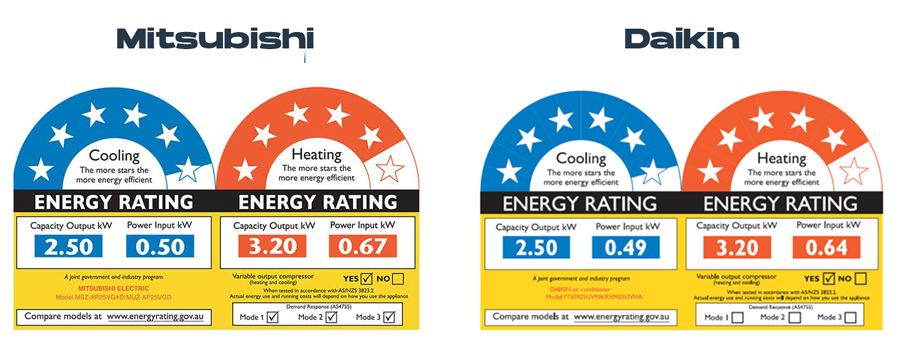
Energy Efficiency Ratio (EER) measures your air conditioner’s performance under specific peak conditions, typically at high outdoor temperatures. Annual Energy Efficiency (AEER) takes a broader approach. Instead of focusing on peak conditions alone, it considers varying temperatures and cooling demands from spring through fall, providing a more realistic picture of year-round efficiency. Higher EER or AEER numbers indicate better efficiency. Units with high ratings produce more cooling per unit of electricity consumed, translating to lower energy bills and reduced environmental impact.
The Daikin ac brand performs slightly better compared to Mitsubishi in terms of energy efficiency in heat or cool. Daikin specialises in air conditioning products, while Mitsubishi’s product range extends beyond smart air conditioners.
This is all great and all, but what does this mean in the real world? How do these ratings translate to savings?
Consider the following scenario:
|
Brand / Model |
Rated Power Input (Cooling) |
Rated Power Input (Heating) |
Summer Cost (Cooling) |
Winter Cost (Heating) |
|
Daikin Alira X – FTXM25WVMA |
0.47 kW |
0.64 kW |
$110.01 |
$149.81 |
|
Mitsubishi MSZ-EF Series (2.5 kW) |
0.57 kW |
0.60 kW |
$133.42 |
$140.44 |
With a typical inverter part-load factor applied, the Daikin Alira X (2.5 kW) proves slightly cheaper to run for cooling, saving around $11.70 over a three-month summer compared to the Mitsubishi MSZ-EF. In winter, the Mitsubishi edges ahead by about $4.68 thanks to its lower heating input. Overall, both systems deliver excellent efficiency, but minor differences in power draw can still affect seasonal running costs.
Hunter Valley’s temperature swings demand versatile solutions, reverse cycle air conditioners shine by keeping homes toasty in winter and cool in summer, combining efficiency with flexible comfort.
For maximum energy savings, set your system to 18 to 20°C in winter and 25 to 27°C during summer, as leading consumer sources recommend. Fine-tune settings for daily conditions: use economy mode and close doors to minimize heat loss or gain, and adjust fan speed to boost efficiency.
A reverse cycle air conditioner is a specific system that provides both cooling in summer and heating in winter by reversing the refrigerant flow, unlike standard air conditioners which only cool.
Both the Daikin Alira X and Mitsubishi MSZ-EF 2.5kW are premium reverse cycle units in Australia, tailored for climate-smart heating and cooling with top efficiency.
Getting your Daikin Alira X or Mitsubishi MSZ-EF 2.5 kW air conditioner professionally installed is the first step toward reliable performance. A licensed HVAC technician ensures the system is correctly sized, securely mounted, and properly charged with refrigerant for maximum efficiency.
Once installed, routine care helps keep your unit running smoothly. Clean or replace filters every few months and make sure the outdoor unit is free from leaves, dust, or obstructions that can restrict airflow.
Even with regular upkeep, professional servicing once a year is essential. A qualified technician can check refrigerant levels, inspect electrical components, and detect early signs of wear before they lead to bigger issues.
Regular maintenance doesn’t just improve efficiency. It extends the life of your system and maintains healthy indoor air quality. If your air conditioner isn’t performing as expected, our team can restore it to peak condition quickly and safely.
If you’re looking for a high-quality air conditioner, you can’t go wrong with either Daikin or Mitsubishi Electric. Both brands offer models that are reliable and efficient, but size does count.
In cost, Daikin air conditioners are typically more expensive than Mitsubishi Electric models. However, this is not always the case. It really depends on the specific model you’re looking at. Daikin models are more expensive to purchase but may be cheaper to operate over the long run because of their higher efficiency ratings. As for installation costs, both brands should cost about the same to install. Call us for a detailed quotation of air conditioner installation costs.
So, which is the better choice? It comes down to your needs, the environment we’re installing your unit in, and your budget. If you call us, we’ll take the hassle out of the decision making process for you, by visiting your property and assessing the area and best installation methods. If you’re looking for an air conditioner that’s affordable and easy to install, then Mitsubishi Electric is a good option. However, if you want an air conditioner that’s more efficient and has a longer lifespan, then Daikin is worth considering.
When choosing between Daikin and Mitsubishi air conditioners, it’s important to consider the features and functionality that each option offers.
Again, let’s do a comparison of Daikon vs Mitsubishi when it comes to air conditioning features:
| Air conditioning model | Air filtration or air purifying features | Our rating | Energy saving technology | Our rating |
| Mitsubishi 2.5kW EF Series | Mitsubishi’s air purification feature is called “Nano Platinum Deodorising Filter,” which removes particulate matters as small as 2.5 micrometers (PM2.5), such as bacteria, virus, allergens, vehicle emissions, mould and dust. | ⭐⭐⭐⭐⭐ | This model has an inverter system that will help you save on energy usage through automatic power adjustment that provides the exact cooling or heating amount your room needs. | ⭐⭐⭐ |
| Daikin Alira X – FTXM25WVMA / RXM25WVMA | Daikin’s streamer technology has advanced air purifiers that remove odours, while filtering bacteria and harmful substances. | ⭐⭐⭐ | Daikin air conditioning uses neodymium magnets, which can boost energy efficiency up to 40% compared to standard ducted air conditioners or split air conditioners. | ⭐⭐⭐⭐⭐ |
It is important to consider the air conditioner maintenance requirements of each type of air conditioner before making a purchase. Daikin air conditioners require less maintenance than Mitsubishi Electric air conditioners. Daikin air conditioners have a self-cleaning function that helps to keep the unit clean and free of debris. Mitsubishi Electric air conditioners do not have this self-cleaning function and therefore require more frequent cleaning.
That said, you should always have your air-con units serviced annually to ensure your family is breathing healthy air and you’re operating the units within the warranty terms and efficiently.
Both Mitsubishi and Daikin offer 1.5-tonne ACs, which should be sufficient to cool a medium-sized room or area. However, it’s important to ensure that the AC’s cooling capacity matches the size of the room or area it’s in because if it is too small, it may struggle to cool the room effectively, while if it is too large, it may cool the room too quickly without removing enough humidity, leading to discomfort and wasted energy.
The table below shows the recommended cooling capacities (in kilowatts) for different room sizes, helping you match your air conditioner to your space. An undersized unit will struggle to cool the room effectively, leading to higher energy use and uneven temperatures, while an oversized system may cycle on and off too often, wasting power and wearing out components faster. By choosing the right capacity for your room size, you ensure consistent cooling, lower running costs, and a longer lifespan for your air conditioner.
| Room Size | Typical Examples | Suggested Cooling Capacity |
|---|---|---|
| Small (up to 20 m²) | Bedroom, study, or compact kitchen | 2.0 – 2.5 kW |
| Medium (20 – 40 m²) | Bedroom with ensuite, or small lounge | 2.5 – 5.0 kW |
| Large (40 – 60 m²) | Large bedroom, medium lounge, or spacious kitchen | 4.0 – 6.0 kW |
| Extra Large (60+ m²) | Open-plan living areas or large lounges | 5.0 – 9.0 kW |
Note that these are general guidelines, and other factors such as ceiling height, number of windows, and insulation of the room may need to be considered when selecting the right size air conditioning unit for a room.
Consulting with a professional HVAC technician can help ensure that you choose the right size AC unit for your specific needs.
Choosing between Daikin vs Mitsubishi Electric air conditioners can be a daunting task, but by taking the time to consider their price, energy efficiency, noise levels, warranty coverage and other essential factors, you can make an informed decision that will serve your needs. Ultimately, let our professional installation technicians make an assessment and give you your best options to choose from. Both brands offer reliable products with great features so whichever one you decide to go with should help keep your home cool and comfortable during hot summer days.


We are proud to serve a wide range of locations across the Hunter Valley region. Whether you need air conditioning, refrigeration, or solar solutions, our expert team is ready to provide fast, reliable service. Explore the areas we cover below, and get in touch with us for tailored solutions designed to meet your needs, wherever you are.