Last updated on November 17, 2025
Solar air conditioners are showing up on more Australian roofs every year, but do they actually deliver on their promises? It’s a fair question, especially when you’re considering the upfront investment of solar airconditioning or a solar AC system.
A solar air conditioner works by running your air conditioning on electricity generated from rooftop panels rather than pulling power straight from the grid. The concept sounds good in theory. During Hunter Valley’s summer, when the sun is shining its brightest, your air conditioner works hardest, and the solar panels produce their maximum output. It’s a perfect match between solar energy and air conditioning work.
Most models operate in hybrid mode too. They draw solar power when it’s available and switch to grid electricity when needed. That means your cooling doesn’t cut out when clouds appear or the sun isn’t at its peak.
But does this setup genuinely reduce energy bills and perform reliably? Let’s examine the pros and cons of solar power air conditioning systems.
This depends entirely on matching your system size to your cooling needs. Most residential split air conditioning units draw between 1.3 and 2.5 kilowatts during operation. Here’s how the maths works out.
Say your air conditioner is rated at 1.5 kilowatts. You’ll need a solar PV system of at least 3 kilowatts to cover that demand effectively during daylight hours. That’s double the air conditioner’s rating because you need enough capacity to handle peak loads and inefficiencies in your air conditioning work.
Hunter Valley gets around 4.76 kilowatt-hours of solar power daily on average throughout the year. Summer bumps that up to 6.27 kilowatt-hours per day. A 3 to 5 kilowatt solar air conditioning system in this region can generate enough power to run your typical home air conditioning for several hours each day during sunny months.
The bottom line? Solar power air conditioning can absolutely provide enough energy, but only if your array is sized properly for your cooling requirements and system efficiency.
Before you start planning your solar powered air setup, you need to understand what you’re actually powering. A medium-sized reverse-cycle AC system consumes between 3 and 5 kilowatt-hours for every hour it runs. That’s a significant draw, especially during those stretches where your air conditioner runs continuously.
Here’s a practical example. Your standard 1.5-ton split system pulls about 1.5 kilowatts per hour. To run an air conditioner comfortably on solar power, you’ll want a 6 to 6.6 kilowatt array. Why larger? Because you need buffer capacity for cloudy moments and system inefficiencies that affect how solar air conditioning systems perform.
Now, for your roof space. Each panel generates between 250 and 350 watts in ideal sunlight. That 6 kilowatt system translates to 16 to 20 panels physically installed on your roof. More precisely, running your 1.5 ton air conditioner efficiently takes about 10 to 12 panels at 300 watts each, assuming Hunter Valley’s typical 4 to 5 hours of peak sun daily.
Your actual number varies based on your AC system’s efficiency and how often you run it, especially during air conditioning at the day’s hottest points.
Winter changes everything for solar power air conditioning output. Hunter Valley’s peak sunlight hours drop from around 4.5 to 6 hours in summer down to just 2 to 3.5 hours during winter months. Your panels produce significantly less when the sun isn’t shining as long.
This creates two sizing approaches depending on your goals. For full solar air conditioning coverage of a 1.5 kilowatt reverse-cycle system running several hours daily, you’ll need about 6 kilowatts of capacity. That’s 16 to 20 panels at 300 watts each.
However, if you’re only supplementing grid power rather than replacing it entirely, or if your air conditioner runs fewer hours or operates more efficiently, 5 to 12 panels (roughly 1.5 to 3.6 kilowatts) might suffice. The smaller setup won’t operate at night, but it’ll still help reduce energy bills considerably.
This flexibility makes solar air conditioning systems a common option for homeowners wanting to balance cost and efficiency in sunny areas.
This depends entirely on when you actually need cooling. Batteries store excess solar power from daytime production, making it available after sunset when your panels stop generating power.
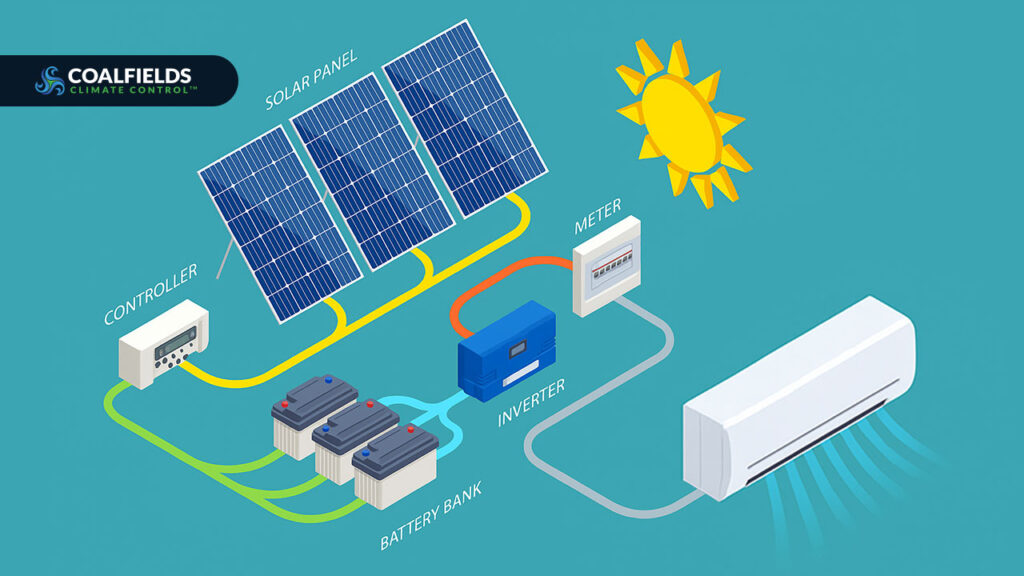
The appeal is obvious, it lets your AC system continue air conditioning work even when the sun isn’t shining.
Numbers matter here. Running a 1.5 kilowatt split system for 6 hours overnight needs at least 9 kilowatt-hours of usable storage. That calculation doesn’t even include inverter inefficiencies, compressor and fans, or other household appliances running simultaneously. Whole-home cooling overnight might require 15 to 20 kilowatt-hours or larger.
So if you only cool your home during sunny hours, skip the batteries. If overnight comfort or blackout protection matters to you, the investment makes sense, especially if you value energy efficiency and eco-friendly living.
You’ve got three main options. Direct DC systems run purely on solar power without converting to AC first, making them highly efficient. Hybrid systems switch between solar and grid power automatically. Then there’s the retrofit approach, where you add solar panels to power your existing ac unit. The best choice depends on your current AC system and whether you’re building new or upgrading.
Your solar system generates electricity that powers your air conditioning just like grid power would. The panels feed energy to an inverter, which converts it to usable power for your ac unit. Your refrigerant cycle and evaporator work exactly the same way. Most homeowners keep their existing equipment, just pairing it with appropriately sized panels to power the cooling load.
Yes, but you’ll need enough panels to power your AC for your home during operating hours. A typical setup requires 10 to 20 panels depending on your unit’s size and runtime. Even without batteries, you can run completely on solar during daylight hours. Adding storage lets you cool your space after sunset too, though that increases your investment significantly.
Australian government rebates for solar installations can substantially reduce your upfront costs. The exact rebate amount varies by state and changes periodically. Your installer should know available programs and help you claim eligible incentives. These rebates typically apply to the solar system itself rather than the air conditioning equipment.
Your panels still generate electricity on cloudy days, just at reduced capacity. Most systems handle this through hybrid operation, automatically drawing from the grid when solar output drops. Even without full sun, you’ll still offset some energy costs. Battery storage provides another buffer during extended overcast periods.
Look for someone licensed in both solar and HVAC work. They need to understand panel sizing, electrical requirements, and how cooling systems operate. Ask about their experience with similar installations in Hunter Valley specifically. A qualified installer will assess your roof space, calculate your actual needs, and explain your options clearly before you commit.
Not usually. Most existing air conditioning systems work perfectly fine with solar power. You’re simply changing the electricity source, not the cooling equipment itself. The key is properly pairing your solar capacity with your unit’s power draw. Older, inefficient systems might be worth upgrading anyway to maximise your solar investment.
Panel placement matters enormously. North-facing panels in Australia capture maximum sunlight. Your air conditioning’s efficiency rating affects how much power you actually need. System losses from inverters and wiring reduce overall performance by 10 to 20 percent. Regular maintenance keeps both your panels and cooling equipment running at peak efficiency year-round.
Solar powered air conditioners work well in Hunter Valley when sized correctly. The challenge? Getting those calculations right on your installation. Five panels or twenty? Do you want to go off-grid completely or are you okay with drawing power from the grid? Winter performance or summer priorities?
These decisions affect your electricity bills, energy use, and initial costs for years to come.
Our team assesses your actual cooling needs, calculates your panel requirements based on Hunter Valley conditions, and designs eco-friendly AC systems that fit your budget. No guesswork, just proper sizing that helps you achieve energy independence and sustainable comfort.
Ready to reduce energy bills and enjoy the comforts that accompany cleaner, eco-friendly solar air conditioning? Contact us for a custom installation quote today.


We are proud to serve a wide range of locations across the Hunter Valley region. Whether you need air conditioning, refrigeration, or solar solutions, our expert team is ready to provide fast, reliable service. Explore the areas we cover below, and get in touch with us for tailored solutions designed to meet your needs, wherever you are.