






Barrel Room HVAC Systems We Service

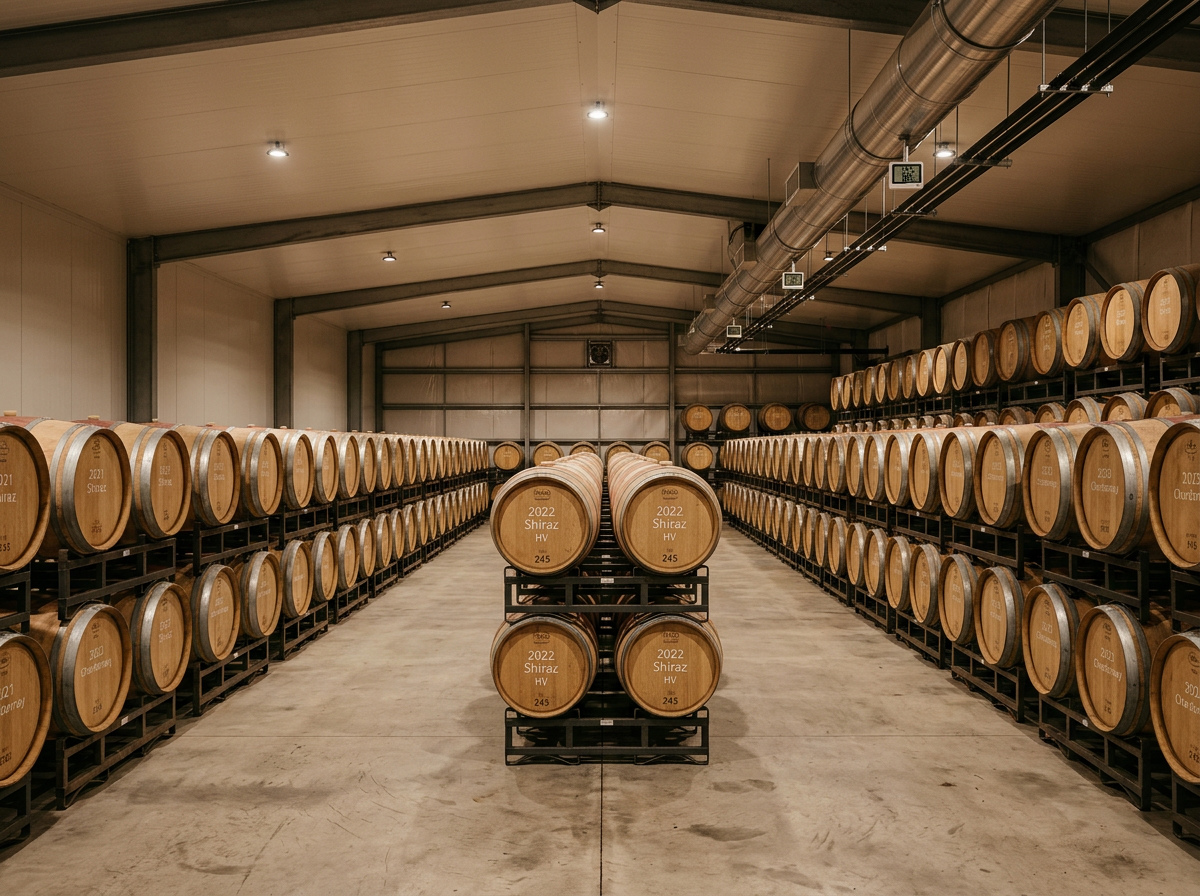
Coalfields Climate Control installs, services and repairs the climate control equipment that keeps Hunter Valley barrel rooms within spec. Whether you are maintaining an existing system or fitting out a new barrel store, we can design and support a solution that holds the conditions your wine requires.

A stable barrel room is a controlled environment, not simply a cool room. Temperature, relative humidity, air movement, outside-air infiltration and the building envelope all interact. If one of those factors is ignored, the refrigeration plant may run correctly while conditions still vary between racks, walls or seasons.

The right operating conditions are ultimately set by the winery and the wine program. Our role is to make sure the mechanical system can achieve those set points consistently, measure them accurately and alert the right people when performance begins to drift.

Barrel room climate control typically involves a combination of cooling, heating, humidification, dehumidification and ventilation. The specific equipment depends on room size, barrel count, building construction and winemaker preferences. We service ducted split systems, fan coil units fed by glycol loops, standalone precision climate units, humidifiers and dehumidifiers, and the control systems that integrate them.

For wineries that share their glycol chiller between fermentation cooling and barrel room climate control, we ensure the system is balanced so that barrel room conditions are not compromised when the chiller is under heavy load during vintage.

5.0 Stars - Based on 286 User Reviews

What Determines the Barrel Room Climate Load

Cooling capacity is only one part of the calculation. Roof and wall insulation, vapour barriers, door area, door-opening frequency, lighting, occupancy, adjoining production spaces and outside-air leakage all affect the heat and moisture entering the room. A system may therefore struggle because of an envelope or infiltration problem even when the refrigeration equipment itself is serviceable.

Moisture control is especially important. The system must manage both sensible load, which changes air temperature, and latent load, which changes moisture content. Equipment selected only for temperature can cool the room yet leave relative humidity unstable, create condensation on cold surfaces or remove more moisture than the wine program intends.

5.0 Stars - Based on 286 User Reviews
Barrel Room Climate Control Hunter Valley

Common Barrel Room Climate Issues We Diagnose and Repair

Temperature fluctuations. Barrel rooms are sensitive to outdoor temperature swings, particularly in buildings with poor insulation. A cooling system that cycles intermittently rather than maintaining a steady set point can stress both the wine and the barrels. We diagnose whether the issue is undersizing, poor insulation, incorrect control settings or equipment fault.

Humidity drift. Without active humidification or dehumidification, barrel room humidity follows the ambient conditions outside. In the Hunter Valley, this can mean excessive humidity in summer and dry conditions in winter. We install and maintain humidity control equipment and calibrate sensors to keep readings within your target range.

Mould and mildew. Excessive humidity combined with poor ventilation creates ideal conditions for mould growth – a common issue in the Hunter Valley’s climate. Proper air circulation, humidity control and regular maintenance of drain lines and drip trays help prevent it. We address both the equipment and the environmental factors.

System undersizing. A barrel room that has grown over time may outgrow its original climate control system. If the system cannot maintain stable conditions during summer, it may need upgrading or supplementing. We can assess current capacity against the actual heat load and recommend the right solution.

Uneven conditions within the room. Poor air distribution can produce warm pockets, cold draughts or humidity differences between racks even when the wall controller appears normal. We check supply and return airflow, fan operation, obstructions, diffuser placement and sensor location rather than relying on a single reading.

Condensation on walls, ducts or pipework. Surface condensation can point to air leakage, missing vapour control, damaged insulation, cold bridges or humidity that is too high for the surface temperature. Treating the visible water without identifying the moisture path usually allows the problem to return.

Sensor and control errors. A humidity sensor mounted near a door, supply-air stream or damp surface may not represent the room as a whole. Drift, poor placement, conflicting set points and short control differentials can also cause excessive cycling. We compare installed sensors with calibrated references and review how the controller sequences cooling, heating, humidification and dehumidification.

5.0 Stars - Based on 286 User Reviews
Barrel Room Climate Control Hunter Valley

Clients we work with

Hughs-mechanical-logo
Leaves-&-Fishes-logo
mcdonalds-logo
Taylor-&-Thomas-Logo

How We Assess an Existing Barrel Room

Room conditions. We review temperature and humidity trends, map conditions at representative rack locations and look for patterns linked to time of day, weather, door use or production activity.

Mechanical performance. We check filters, coils, fans, condensate drains, humidifiers, dehumidifiers, refrigeration operation, electrical components and the control sequence under realistic demand.

Building influences. We inspect accessible insulation, door seals, penetrations, vapour-control weaknesses and air leakage indicators that may be adding heat or moisture faster than the system can remove it.

Capacity and resilience. We compare current barrel count, room use and peak seasonal load with the installed plant, then identify critical failure points, monitoring gaps and practical contingency options.

This assessment helps distinguish a maintenance issue from a control problem, an air-distribution fault, a building-envelope weakness or genuine capacity shortfall. The recommended work can then target the cause instead of simply forcing the set point lower.

5.0 Stars - Based on 286 User Reviews
Barrel Room Climate Control Hunter Valley

Remote Monitoring for Barrel Rooms

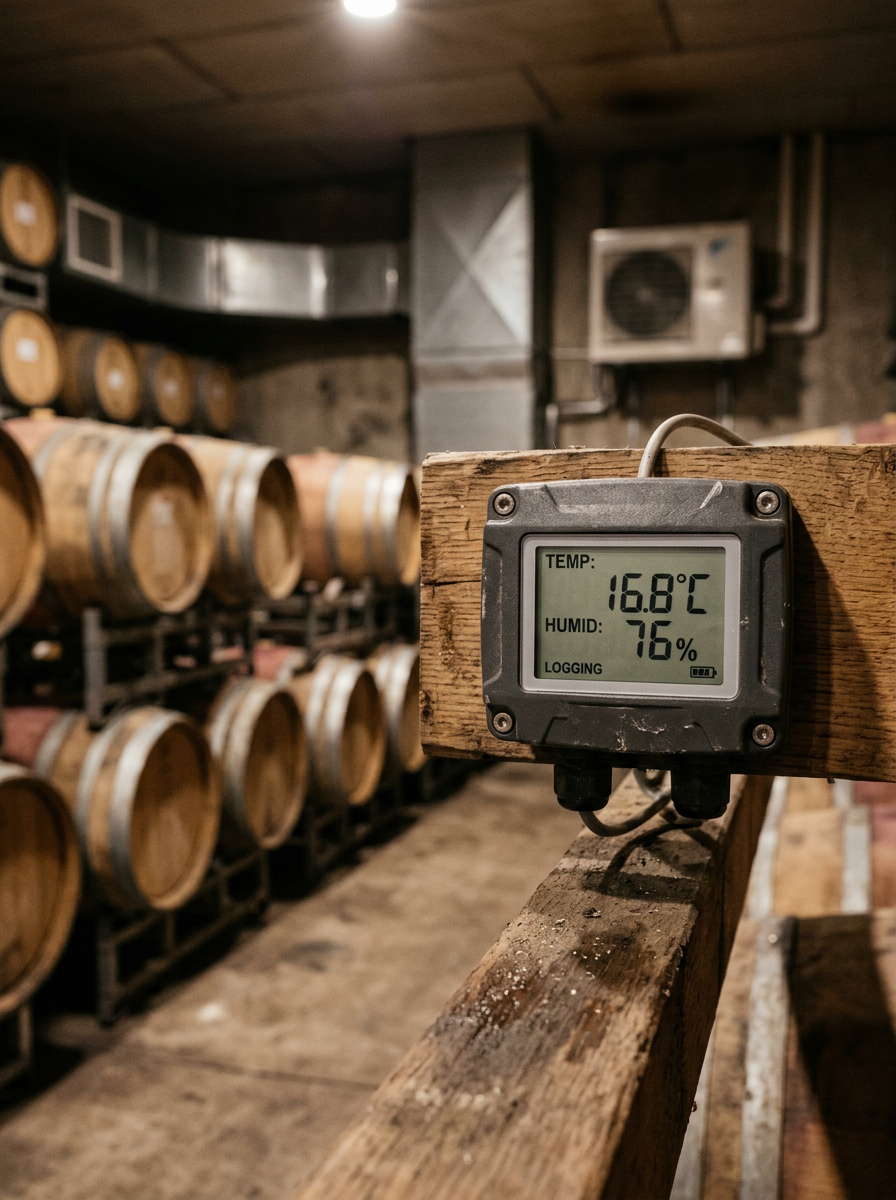
Barrel rooms are often unattended overnight and over weekends. A climate control failure can go unnoticed for hours. We install remote monitoring devices that track temperature and humidity continuously and alert you or our team the moment conditions drift outside the target range. For a room holding significant stock value, this level of oversight is a practical safeguard, not an optional extra.

Good monitoring depends on more than installing a sensor. We consider:

Sensor placement. Devices should represent stored-barrel conditions and avoid misleading locations beside doors, supply-air outlets, exterior walls or local moisture sources.

Alarm thresholds and delays. Alerts should identify meaningful drift while allowing for normal door openings and short operating cycles, reducing nuisance alarms that staff may begin to ignore.

Escalation and response. The system should identify who receives the first alert, when it escalates and what information staff should check before a technician attends.

Trend history. Temperature, humidity and equipment data can reveal gradual degradation, seasonal patterns or repeated cycling that a single spot reading will miss.

5.0 Stars - Based on 286 User Reviews
Barrel Room Climate Control Hunter Valley

What to Record Before a Service Call

Note the current temperature and humidity, the controller set points, when the drift began, whether the issue affects the whole room or a particular area, and any active alarm or fault code. Also note recent door activity, water or condensation, unusual fan or compressor noise, and whether fermentation or other glycol loads are operating at the same time. This context helps us prepare for the likely fault.

Call Coalfields Climate Control on 0422 493 102 to discuss barrel room climate control for your winery.

5.0 Stars - Based on 286 User Reviews
Hunter-Valley-residential-aircon-service

Brands we recommend

Daikin-air-condioner-logo
Fujitsu-air-conditioning-logo
Actron-Air-Logo

Frequently Asked Questions Barrel Room

  • 12°C to 16°C, held as consistently as possible. Temperature stability matters more than hitting an exact number. Fluctuations cause the wine to expand and contract in the barrel, which can increase oxidation and accelerate ageing unpredictably.

  • 65% to 75% relative humidity. Below 60%, barrels dry out and evaporation losses increase. Above 80%, mould growth becomes a significant risk. In the Hunter Valley’s variable climate, active humidity management is almost always necessary.

  • Yes. We assess the room’s construction, insulation, size and barrel capacity, then design a system that fits the space and budget. Retrofitting is common in the Hunter Valley as wineries grow and convert existing buildings into barrel storage.

  • Temperature and humidity loads do not always move together. The cooling stage may be undersized, restricted or poorly controlled while the humidity equipment continues to hold its set point. Sensor placement can also make the readings appear better than conditions at the barrels. Testing both the room and the equipment under load is needed to isolate the cause.

  • Common causes include blocked airflow, poorly positioned diffusers, fan problems, external heat gain, door infiltration and a controller sensor that represents only one location. Multi-point measurements show whether the issue follows the airflow pattern, the building envelope or the mechanical plant.

  • Yes, provided the chiller, pumps, pipework and controls can manage the simultaneous peak load. A shared system should be assessed for priority control and flow balance so heavy fermentation demand does not allow barrel room conditions to drift unnoticed.

  • There is no useful one-size-fits-all number. Room size, layout, rack height, airflow, external walls and door locations determine the monitoring points. The aim is to capture representative conditions and known risk areas without creating a flood of redundant data.

  • Quarterly. These systems run continuously throughout the year. Service visits cover filter cleaning or replacement, coil inspection, humidity system checks, drain line clearing and sensor calibration.

Got another question? Contact us and ask

Ask a Question

    The field is required.

    The field is required.

    The field is required.

    Thank you for your message. It has been sent.

    Our Service Areas

    We are proud to serve a wide range of locations across the Hunter Valley region. Whether you need air conditioning, refrigeration, or solar solutions, our expert team is ready to provide fast, reliable service. Explore the areas we cover below, and get in touch with us for tailored solutions designed to meet your needs, wherever you are.