Last updated on July 30, 2026
By the time most homeowners call an air conditioning technician, they’ve usually done what everyone else does.
They’ve searched Google.
They’ve watched a few YouTube videos. They’ve asked friends or neighbours.
Unfortunately, that’s also where a lot of misinformation begins. One person says it’s “probably out of gas.”
Another says, “It’s definitely the compressor.”
Someone else recommends simply resetting the breaker until it starts working again. Sometimes those suggestions are harmless.
Other times they can turn a relatively minor repair into a much larger and more expensive problem.
One of the most valuable things an experienced technician brings isn’t just the ability to repair a system—it’s knowing what not to assume.
Let’s look at some of the most common myths we hear across the Hunter Valley.
This is probably the biggest misconception in the air conditioning industry. Many people describe refrigerant as though it’s petrol in a car.
“It must have run out.”
In reality, your air conditioner is a sealed refrigeration system. It doesn’t consume refrigerant.
It doesn’t burn it.
It doesn’t slowly use it over time.
If refrigerant is low, there’s almost always a reason.
That usually means there’s a leak somewhere in the system.
Adding more refrigerant without repairing the leak is a bit like continually topping up a leaking tyre without fixing the puncture.
Eventually, the problem returns.
A proper repair should always involve:
Homeowners often assume the compressor is the first thing to fail. Ironically, it’s often one of the last.
Compressors are extremely robust pieces of equipment. Many operate reliably for well over a decade.
Before a compressor is condemned, experienced technicians will usually investigate a range of simpler possibilities.
Common examples include:
These components are generally far more likely to cause startup problems than the compressor itself.
That’s one reason proper diagnosis matters.
Replacing expensive components based on guesswork rarely ends well.
Age is only one part of the equation.
We’ve serviced fifteen-year-old systems that continue to perform exceptionally well. We’ve also seen five-year-old systems that have suffered significant neglect.
Instead of focusing purely on age, consider:
Sometimes repairing an older unit makes perfect financial sense. Other times replacement genuinely is the better investment.
A trustworthy technician should explain both options—not automatically recommend the more expensive one.
It’s easy to assume that installing the biggest system available guarantees the best performance. In reality, oversized air conditioners often create new problems.
When a system is too large, it cools the room too quickly.
That sounds positive but it means the unit switches off before removing enough humidity from the air.
The result can be:
Correct sizing is far more important than maximum capacity.
That’s why professional heat-load calculations are still one of the most valuable parts of a quality installation.
This one quietly costs homeowners thousands of dollars every year. Many people assume:
“If cold air is coming out, everything must be fine.” Unfortunately, air conditioners rarely fail without warning.
More often, performance slowly declines over months—or even years.
By the time cooling noticeably suffers, components may already have been operating under unnecessary stress.
Routine servicing isn’t simply about cleaning filters. A comprehensive service checks:
Many expensive repairs begin as small issues that could have been identified during routine maintenance.
Every region has its own environmental conditions.
Because of the Hunter Valley’s climate, dust levels and extended summer heat, certain faults appear more frequently than others.
Here’s what we commonly encounter.
Probably the most preventable issue we see.
During summer, filters can become clogged surprisingly quickly. Dust from rural roads.
Pollen.
Bushfire smoke.
Pet hair.
General household dust.
Restricted airflow doesn’t just reduce cooling.
It also forces the system to work harder, increasing electricity consumption while placing additional strain on the compressor.
Fortunately, it’s also one of the easiest problems to prevent.
Capacitors help electric motors start efficiently.
Like any electrical component, they gradually deteriorate with age. Hunter Valley heat accelerates that process.
A weakening capacitor may still work during mild weather but fail completely during a prolonged heatwave—precisely when your air conditioner is under its greatest load.
This is one reason many systems seem to “randomly” stop working on the hottest day of the year. The failure often isn’t random at all.
The heat simply exposed a component that was already nearing the end of its service life.
Water removal is an essential part of the cooling process.
When condensate drains become blocked by algae, mould or debris, water has nowhere to go. Modern systems often shut themselves down before overflow causes damage inside the home. Catching the blockage early is usually far less expensive than repairing water-damaged ceilings.
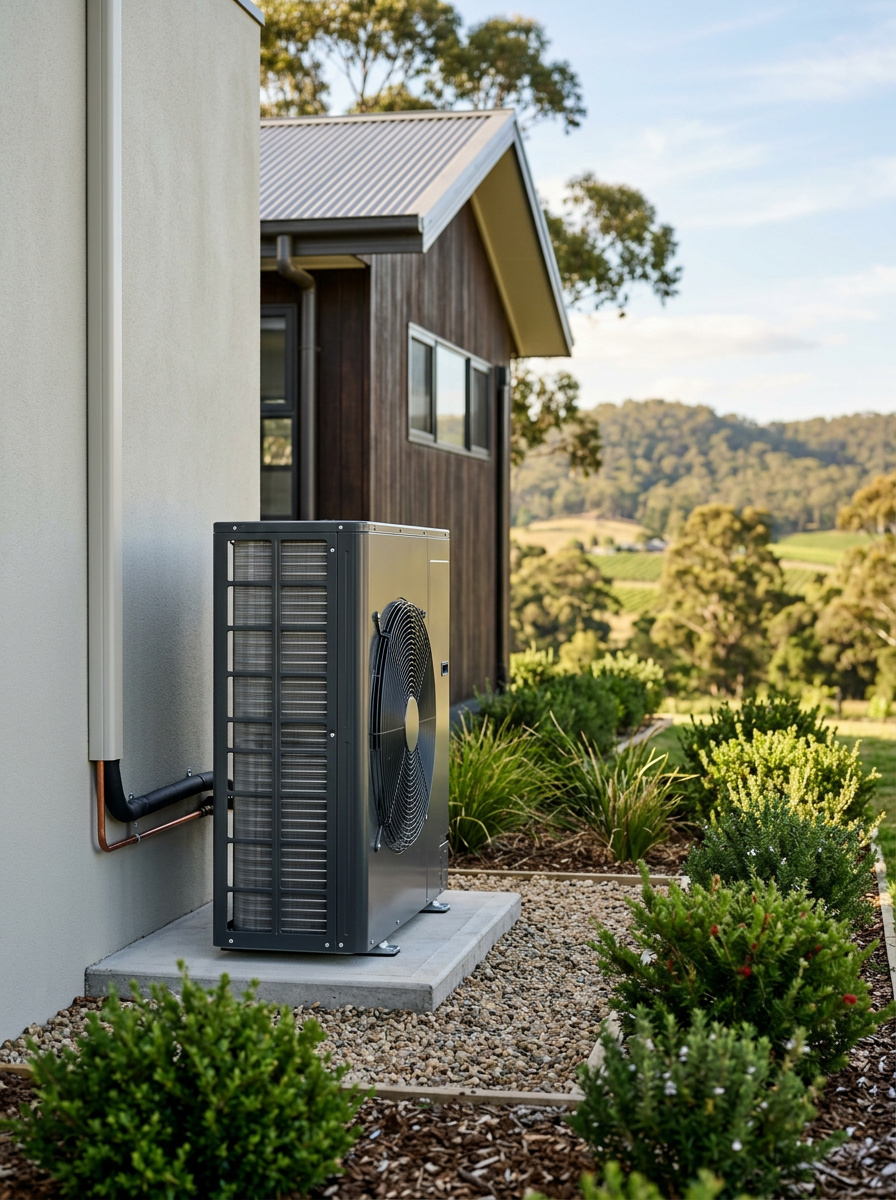
Outdoor condensers need unrestricted airflow. Unfortunately, many gradually become surrounded by:
We’ve even found outdoor units hidden behind garden renovations completed years after installation.
Keeping at least several hundred millimetres of clear space around the unit dramatically improves efficiency.
Air conditioners experience constant vibration.
Over many years, electrical terminals can gradually loosen.
Combined with Hunter Valley heat, those loose connections create additional resistance. Additional resistance creates heat.
Heat damages components.
Routine servicing often identifies these issues long before they become failures.
Many homeowners understandably wonder what they’re paying for when booking a service call. A proper diagnosis involves much more than replacing the first part that looks suspicious.
An experienced technician follows a logical process. Typically this includes:
Looking for obvious signs of damage, corrosion, oil stains or overheating. Electrical testing
Checking incoming voltage, current draw and component operation. Airflow assessment
Inspecting filters, evaporator coils, condenser coils and fan performance. Refrigeration performance
Measuring operating pressures and temperatures to determine whether the refrigeration cycle is functioning correctly.
Checking for blockages and ensuring condensate is draining properly. Control system testing
Confirming sensors, circuit boards and communication systems are operating correctly. Only after collecting this information should repair recommendations be made.
Diagnosis based on evidence—not assumptions—is what separates experienced technicians from parts changers.
One question we’re often asked is:
“Should I repair it, or replace it?” There’s no universal answer.
Instead, we look at several factors together. Repair usually makes sense when:
Replacement may be worth considering when:
Good advice isn’t about selling new systems.
It’s about helping homeowners make financially sensible decisions based on the condition of their existing equipment.
One of the biggest lessons we’ve learned after servicing homes across the Hunter Valley is this: Air conditioners rarely fail overnight.
Most expensive repairs begin as relatively minor problems. A blocked filter.
A weakening capacitor. A partially blocked drain. A dirty condenser coil.
Ignored for long enough, those small issues place extra stress on larger components. Eventually something much more expensive fails.
That’s why preventative maintenance isn’t simply about extending the life of your air conditioner.
It’s about reducing the likelihood of inconvenient—and often avoidable—breakdowns during the middle of summer.
In the final section, we’ll look at how to keep your air conditioner operating reliably throughout the year with a practical Hunter Valley maintenance calendar.
We’ll also answer the most common questions homeowners ask, explain what to expect from annual servicing, and finish with practical advice on getting the best performance and lifespan from your air conditioning system. That final section will also include a detailed FAQ, suggested internal links, metadata and schema recommendations to help this guide become a long-term cornerstone resource for Coalfields Climate Control.


We are proud to serve a wide range of locations across the Hunter Valley region. Whether you need air conditioning, refrigeration, or solar solutions, our expert team is ready to provide fast, reliable service. Explore the areas we cover below, and get in touch with us for tailored solutions designed to meet your needs, wherever you are.